I am a physics undergraduate at KAIST (B.S. expected February 2027, minor in Electrical Engineering).
Since joining Prof. Junhan Kim's OBSCAL group in Fall 2024,
I have modeled the X-ray emission of hot gas around galaxies in IllustrisTNG, and since January 2026 I have worked at KASI
with SPHEREx data, measuring the rest-frame optical spectra of quasars at z > 5.
My long-term goal is to become an observational astronomer who works across observations, simulations,
and instrumentation, connecting multi-wavelength data from X-ray to radio with theoretical predictions.
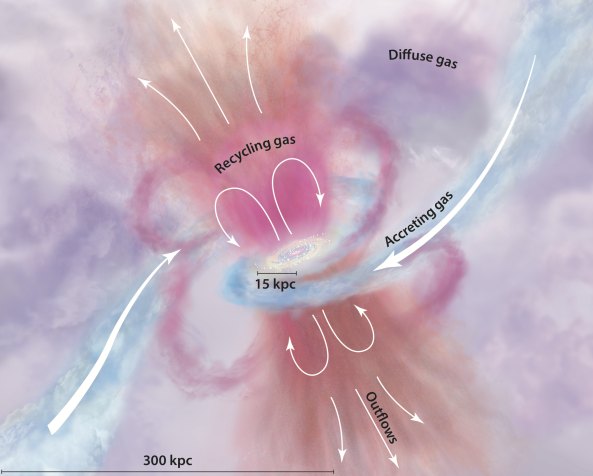
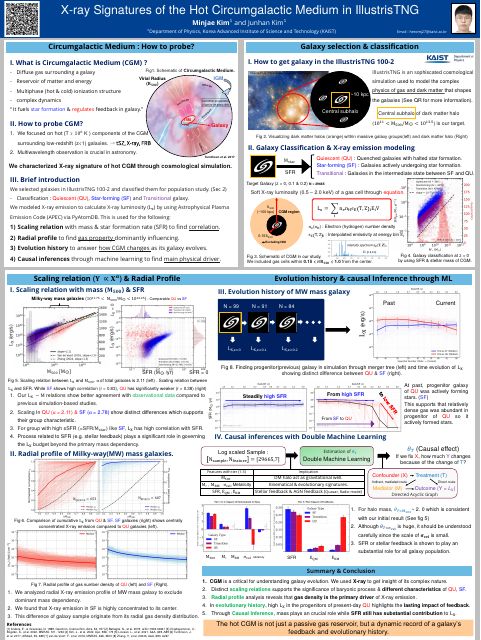
The circumgalactic medium (CGM) is the diffuse, multiphase gas that surrounds a galaxy: it fuels star formation and records
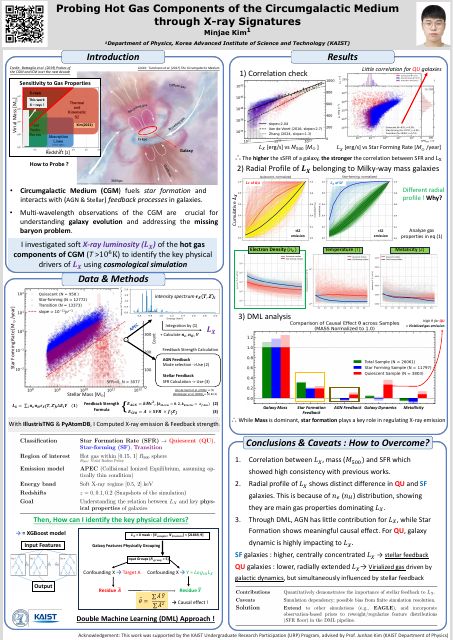
every episode of feedback. I model the intrinsic 0.5–2 keV emission of its hot (T ≥ 106 K) phase for
30,180 central galaxies in IllustrisTNG (TNG100-2) at z = 0–0.2, computing emissivities with the APEC model under
collisional ionization equilibrium, and ask why quiescent galaxies are so much fainter in soft X-rays.
Key results
~5×
Star-forming galaxies are about five times more luminous in soft X-rays than quiescent galaxies of similar mass.
Redistributed, not removed
Quiescent galaxies keep a similar hot-gas mass and tSZ signal; their hot gas sits at larger radii, so LX ∝ ne2 drops.
α = 1.90 ± 0.21
The LX–M500 relation is steeper than the self-similar slope (1.5–1.6), pointing to non-gravitational heating by feedback.
For star-forming and transition galaxies, LX stays correlated with SFR after controlling for halo or stellar mass; for quiescent galaxies the partial correlation is near zero.
Figures
The CGM: accreting, recycling and outflowing gas around a galaxy. Tumlinson, Peeples & Werk (2017), Fig. 1.Dark matter halos (orange) in a massive galaxy group in IllustrisTNG. Credit: TNG Collaboration.Galaxy classification at z = 0: quiescent, star-forming and transition galaxies relative to the star-forming main sequence.CIE cooling function Λ(T, Z) in the 0.5–2.0 keV band from APEC (PyAtomDB).LX scaling with M500 (left) and M* (right): medians and 16th–84th percentiles in 0.1-dex bins, with MCMC power-law fits.LX versus SFR for quiescent, star-forming and transition galaxies.Normalized cumulative profiles of LX (solid) and YtSZ (dashed) for quiescent (left) and star-forming (right) Milky Way-mass galaxies.Distributions of LX, YtSZ and gas mass (solid: hot, dashed: total) for quiescent (red) and star-forming (blue) galaxies.
Cover: Tumlinson, J., Peeples, M. S. & Werk, J. K. 2017, ARA&A, 55, 389, Fig. 1. Simulation image: IllustrisTNG Collaboration. All other figures: Kim & Kim (2026).
Jan 2026 – present
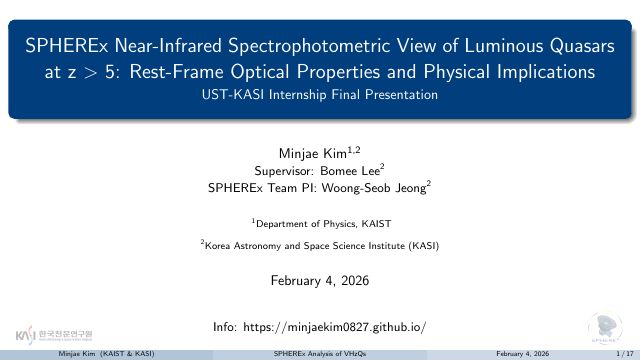
Toward weighing the first supermassive black holes with SPHEREx
Korea Astronomy and Space Science Institute (KASI). Supervisors:
Dr. Bomee Lee and Dr. Woong-Seob Jeong
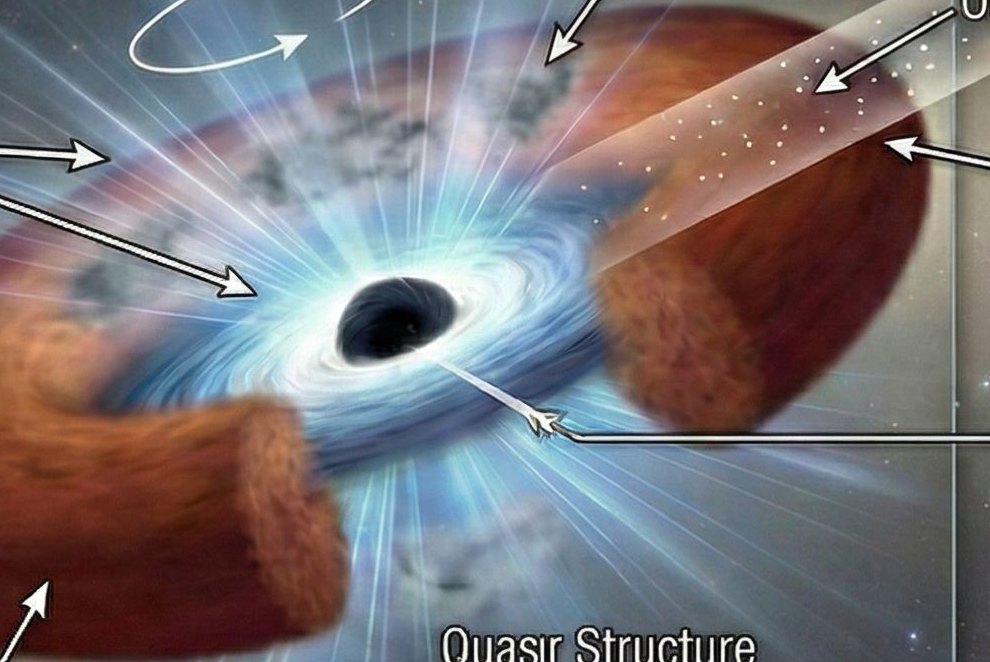
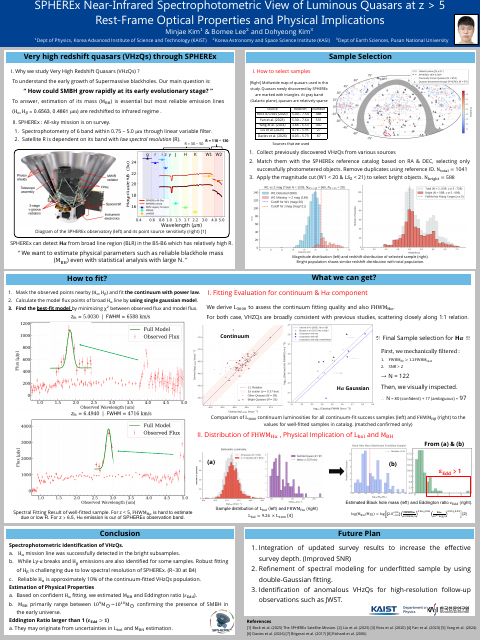
Quasars at z ≳ 5 already host black holes of a billion solar masses, less than a billion years after the Big Bang.
Weighing them reliably needs the Balmer lines, but at these redshifts Hα moves into the infrared, so most masses have relied on
rest-frame UV lines that winds can bias. NASA's SPHEREx maps the entire sky from 0.75 to 5 μm. I am building the pipeline
that measures broad Hα in its low-resolution spectra for luminous quasars at 4 < z < 6.6,
the first step toward Hα-based black hole masses across the whole sky.
Paper in preparation (Kim & Lee). Only the sample and measurement method are shown here; the physical analysis will appear in the paper.
Key results
1,123known quasars at z ≈ 4–7, compiled from five catalogs
1,023with SPHEREx DR1 spectra covering Hα
104reliable broad-Hα measurements at z = 4.1–6.5
How it works
Build the sample
I merged five literature catalogs of high-redshift quasars, matched them to the SPHEREx Reference Catalog, and extracted DR1 spectra with quality flags and Galactic-extinction correction. Most quasars lie away from the Galactic plane, and a few sit in the deep fields at the ecliptic poles.
SPHEREx's first all-sky map of stars (blue, green, white) and gas and dust (red, purple). Credit: NASA/JPL-Caltech.The sample on the sky. Gray: parent sample (1,123); circles: quasars with SPHEREx spectra (1,023), colored by redshift; stars: reliable Hα sample (104). Dashed circles mark the SPHEREx deep fields.Redshift (left) and W1 magnitude (right) of the final and reliable samples. The dashed line is SPHEREx's all-sky 5σ depth at W1 (19.8 AB).
Model what SPHEREx actually measures
Each SPHEREx point integrates the spectrum through a linear variable filter, and the resolution jumps from R ≈ 40 to ≈ 120 between bands. Rather than deconvolving, I forward-model a power-law continuum plus a Gaussian Hα through the measured filter response of every data point, estimate uncertainties with Monte Carlo noise injection, and keep only fits that pass strict reliability cuts.
Resolving power of every data point (colors) and 5σ depth (black) across SPHEREx's six bands. Bands 5–6 resolve broad Hα; bands 1–4 are deeper but coarser.Intrinsic Hα FWHM of the reliable sample, split by the resolution of the band where Hα falls.Rest-frame SPHEREx spectra of the 18 strongly reliable quasars at z = 4.9–6.3, with the best-fit continuum + Hα model (red) and the rest-frame Hα wavelength (dotted).
Next: the physics
With the Hα measurements in hand, the paper in preparation turns them into the physical picture of these quasars:
black hole masses, accretion rates, and how SPHEREx can complement JWST, which observes high-redshift quasars in exquisite detail
but one at a time. Those results are preliminary and will be presented there.
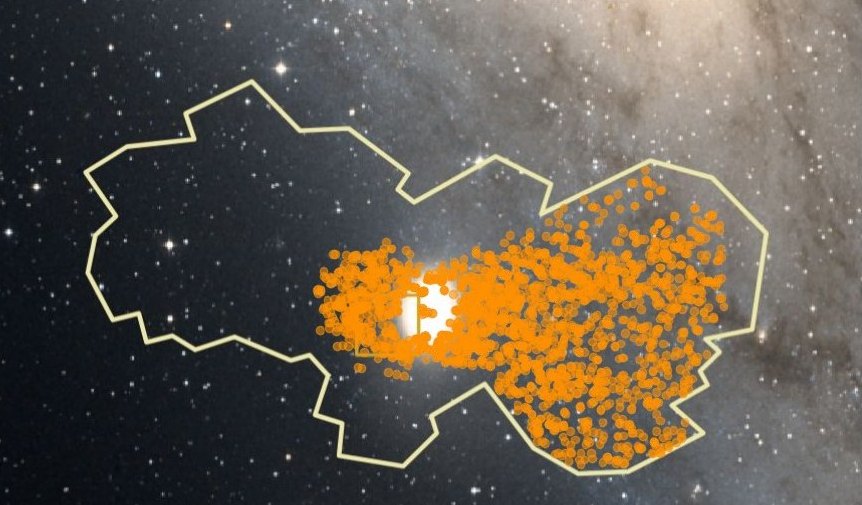
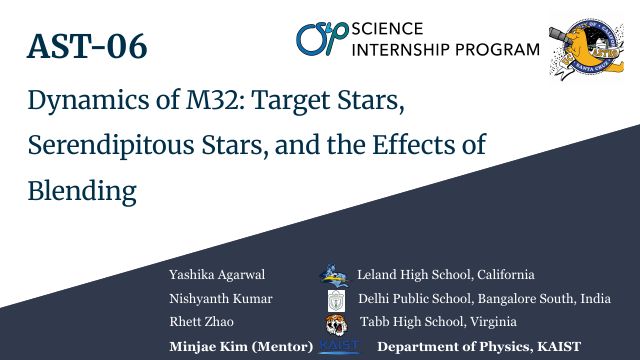
M32, the compact elliptical satellite of Andromeda, is close enough to resolve into individual stars. Keck/DEIMOS spectra of
the field also capture serendipitous stars, sources that fell on the slits by chance and cluster in M32's crowded inner
region. We asked what dynamical information these stars add, and how blending affects it. I led the project while mentoring
three high school interns in UCSC's Science Internship Program.
Key results
9% → 22%
The fraction of M32 members roughly doubles in the serendipitous sample compared with targeted stars.
5-component model
Velocities fit with M32, the M31 disk (tilted-ring model), M31 spheroid, Giant Stellar Stream and Milky Way, compared with dynesty nested sampling.
AAS 247
Presented by my mentee at the 247th AAS Meeting (Jan 2026), with me as a co-author.
Figures
M32 imaged by Hubble for the Panchromatic Hubble Andromeda Southern Treasury (PHAST). Credit: NASA, ESA, B. Williams (University of Washington); processing: G. Kober.Keck/DEIMOS footprint and HST/ACS proper-motion field over M32; orange points are observed stars.Heliocentric velocities separate M31 and M32 (left); radial distribution of stars from M32's center (right).Color–magnitude diagram of targeted (red) and serendipitous (blue) stars with PARSEC isochrones and the tip of the red giant branch.M32-membership-weighted velocity histograms (top) and on-sky membership probabilities (bottom).Best-fit kinematic components for the targeted (left) and serendipitous (right) samples; the M32 component (green) is stronger among serendipitous stars.
Cover: M32, NASA, ESA, B. Williams (University of Washington); image processing: G. Kober (NASA/Catholic University of America). Figures: AST-06 team (Y. Agarwal, N. Kumar, R. Zhao; mentor M. Kim), UCSC Science Internship Program 2025.
Talks & posters
Oral talks and posters, 2025–2026. Click a preview to open the slides or poster.
2026
Korean Astronomical Society Fall Meeting
PosterOct 2026
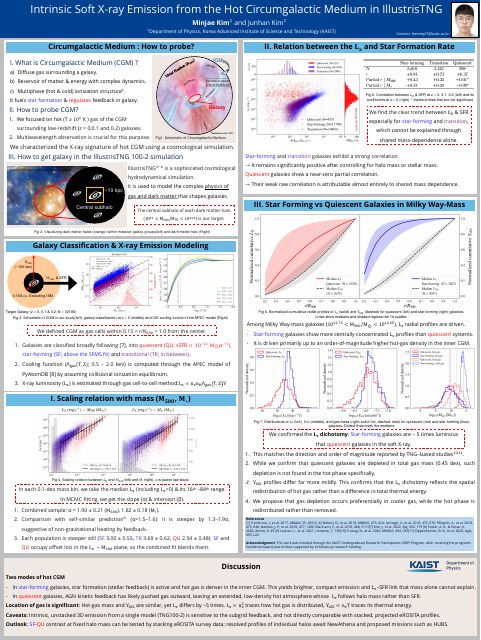
Intrinsic Soft X-ray Emission from the Hot Circumgalactic Medium in IllustrisTNG
Selected coursework: Quantum Mechanics I & II, Mathematical Physics I & II, Statistical Physics, Theory of Relativity and Cosmology, Astrophysics, Radio Astronomy, Computational Physics, Solid State Physics I, Machine Learning
Leave of absence for mandatory military service, Republic of Korea Army (Jan 2022 – Jul 2023)
University of California, Berkeley
Summer 2024
Summer exchange student. Took Introduction to Astrophysics, the course that first drew me into astronomy.
Jeonnam Science High School
2018 – 2019
Early graduation, ranked 2nd in class
Honors & awards
Awards
Best Tutor AwardKAIST Freshman Tutoring ProgramSpring 2026
CERN Korean Summer Student ProgramKorean Physical Society. Studied WIMP freeze-out and FIMP freeze-in in the Higgs-portal scalar singlet model with micrOMEGAs.Jun – Jul 2026
SKA Korea Summer Workshop 2026KASI and KAIST, DaejeonAug 2026
Radio Summer School & Radio Telescope Users' MeetingKorea Astronomy and Space Science InstituteAug 2025, Aug 2026
KASI–UST Winter Internship ProgramKorea Astronomy and Space Science InstituteJan – Feb 2026
NUPS Exoplanet Exploration ClubKAIST. Paper reviews and observation practice.2025
Teaching & mentoring
Undergraduate tutor, General Physics I & II
Fall 2025 – present
KAIST Freshman Tutoring Program
Lead weekly review and Q&A sessions on core physics concepts for freshmen.
Received the Best Tutor Award (Spring 2026).
Research mentor, Science Internship Program
Summer 2025
UC Santa Cruz, Prof. Puragra (Raja) GuhaThakurta's group
Supervised three U.S. high school interns and taught astronomical data analysis, Python, and scientific presentation.
Guided one intern to present our results at the 247th AAS Meeting (Jan 2026).
Skills
Research tools
IllustrisTNG, pyatomdb/APEC, SPHEREx spectral data and fitting pipeline, MCMC (emcee), micrOMEGAs
Programming
Python, Git, LaTeX
Languages
Korean (native), English (TOEFL iBT 110 / 120; band score 5.5 / 6.0)
Military service
Republic of Korea Army, Sergeant, honorable discharge (Jan 2022 – Jul 2023)
News
Papers, talks, awards and time in the lab, with photos.